Free Hosting vs VPS: Which One Should You Choose?
Compare free hosting and VPS hosting by cost, control, performance, maintenance, scalability and project type to choose the right option.
Free Hosting vs VPS: Which One Should You Choose?
Choosing between free hosting and VPS hosting is not simply a question of which option has more resources. The right choice depends on what you are building, how much control you need, your technical experience and whether the website is experimental or already important to users or a business.
Free web hosting can be a practical starting point for a student project, personal website, portfolio, prototype or first attempt at publishing a site online. A Virtual Private Server (VPS), by contrast, gives you a more isolated server environment and significantly more control, but usually introduces both a recurring cost and greater technical responsibility.
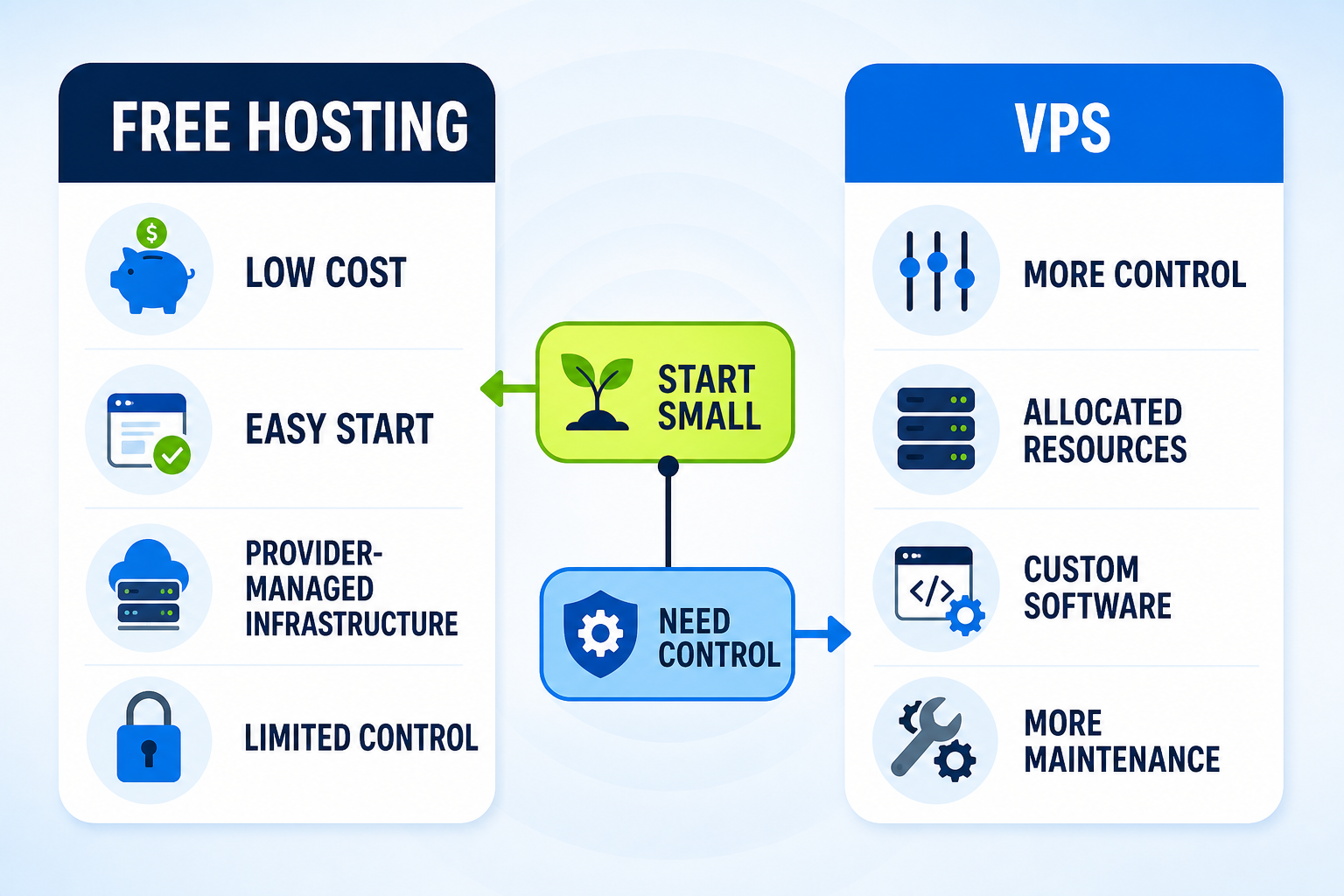
For many new projects, starting with free web hosting is reasonable. A VPS becomes more attractive when your application needs specific server software, predictable resources, advanced configuration or room to grow.
Free Hosting vs VPS at a Glance
| Factor | Free hosting | VPS hosting |
|---|---|---|
| Cost | No hosting subscription | Usually a recurring payment |
| Setup difficulty | Beginner-friendly | Moderate to advanced |
| Server administration | Mostly handled by the provider | Often partly or fully your responsibility |
| Root access | Typically unavailable | Common on unmanaged VPS services |
| Resource control | Limited | Resources are allocated to the virtual server |
| Software configuration | Restricted to supported technologies | Much more flexible |
| Maintenance | Provider manages the underlying server | You may need to maintain the OS and services |
| Scalability | Limited | Usually easier to increase resources |
| Best for | Learning, portfolios, small sites and testing | Custom applications and demanding projects |
Neither option is automatically better. They solve different problems.
What Is Free Web Hosting?
Free web hosting provides server space and hosting features without a normal paid subscription. Instead of configuring an entire server, you work inside an environment prepared by the provider. You upload your website, configure the features available to your account and let the hosting company manage the underlying infrastructure.
This makes free hosting especially useful when your main objective is to get a website online rather than administer a server. Depending on the provider, it may support static HTML, CSS, JavaScript, PHP, databases, FTP, SSL or a content management system. Features and limits vary, so check them before choosing a service. Our guide to what free web hosting is explains the usual limits in more detail.
Free hosting commonly makes sense for:
- Students learning web development.
- Personal websites and portfolios.
- HTML, CSS or small PHP projects.
- Demonstrations and prototypes.
- Temporary websites.
- Early-stage project validation.
- Low-resource experimental applications.
It can also help you learn about domains, DNS, website directories, FTP, databases and publishing workflows without paying for infrastructure first.
What Is VPS Hosting?
A Virtual Private Server, or VPS, is a virtual server created on a physical machine using virtualization technology. Several VPS instances may run on the same hardware, but each operates as an isolated environment with its own operating system and allocated resources.
From your perspective, a VPS can behave much like an independent computer connected to the internet. Depending on the service, you may be able to:
- Select an operating system.
- Install your own web server.
- Configure PHP or another runtime.
- Run background services.
- Configure firewall rules.
- Install databases and system packages.
- Create users and manage SSH access.
- Change server-level configuration.
That flexibility is a major reason developers move to a VPS. However, more control also means more responsibility.
The Biggest Difference: Website or Server?
The simplest way to understand the comparison is to ask what you actually want to manage.
With free hosting, you generally focus on your website. With an unmanaged VPS, you may also need to focus on the server running your website.
VPS tasks can include installing packages, applying operating system updates, configuring Apache or Nginx, securing a database, managing SSH, setting up a firewall, monitoring disk and memory usage, reviewing logs and maintaining backups. If you simply want to publish a portfolio or practise PHP, that extra work may provide little benefit. If you are learning Linux administration or building an application that requires custom infrastructure, the control may be exactly what you need.
Cost, Control and Performance
Free hosting is attractive when the project generates no income, you are testing an idea or paying for infrastructure would not yet provide meaningful value. A VPS normally has a recurring cost, and you may also need to budget for backup storage, monitoring, a control panel, security services or administration.
A VPS is the clear choice when server-level control is a requirement. It can support custom runtimes, background processes, special networking, custom web-server rules and software that ordinary hosting accounts do not support. A simple website does not become better merely because you have root access, though. If you only need the features already offered by a normal hosting account, extra control may add complexity without adding value.
A VPS also normally gives you clearer CPU, memory, storage and transfer allocations. That can help a growing application, but it does not automatically make a website fast. Code quality, database design, caching, image optimisation, network latency and configuration still matter.
For a broader checklist of storage, email, SSL, support and growth, see how to choose web hosting.
Security and Maintenance
With a managed hosting environment, the provider maintains the underlying server platform. You are still responsible for your website, passwords, applications and updates, but you do not administer the whole operating system.
With an unmanaged VPS, your responsibilities may include operating system patches, web-server and database updates, SSH security, user permissions, firewall rules, backups and monitoring. A VPS gives experienced administrators more security control, but it also gives inexperienced administrators more opportunities to make mistakes.
When Is Free Hosting the Better Choice?
Free hosting is usually sensible when you are learning web development, building a portfolio, testing a landing page, preparing a student project or running a low-resource personal site. It lets you publish and validate an idea before committing to more infrastructure.
If your project needs a domain, remember that a domain and hosting are different things. If it needs HTTPS, choose an environment with SSL included; Bacan also explains why your website needs SSL.
When Is a VPS the Better Choice?
Consider a VPS when you need custom server software, server-level configuration, background services, a particular runtime, additional resources or an architecture that a standard hosting environment cannot support. A VPS can also be a valuable learning environment for Linux administration, SSH, networking and deployment, provided that you secure it properly.
Managed VPS hosting can reduce some of the administration work. Always check what “managed” includes: one provider may maintain the operating system while another offers broader application support.
Free Hosting vs VPS for WordPress
WordPress requires a compatible server environment, PHP and a database. A compatible hosting account lets you focus on themes, plugins, content, updates and website management. A VPS gives you control over the WordPress stack, but you may need to configure the web server, PHP, database, caching, backups and security yourself.
For a small experimental installation, a simple hosting account is often enough. For an experienced administrator running a demanding WordPress site, VPS control may be useful. Always check the current requirements of the WordPress version you plan to install.
Common Mistakes
- Choosing a VPS because it sounds more professional. Visitors care about a useful, fast, secure and reliable site, not the label of the server.
- Choosing free hosting for a mission-critical application without checking limits, support, backups and availability.
- Ignoring maintenance after renting an unmanaged VPS.
- Paying for resources you do not need.
- Migrating before there is a real technical or business reason.
Five Questions to Ask
- Do I need server-level control?
- How much traffic and processing does the project require?
- Am I prepared to administer a server, or should I use managed hosting?
- How important is the website to its users or business?
- Can I start smaller and upgrade later?
For many projects, the answer to the last question is yes. Start with a simple environment, learn how hosting works and move to a VPS when the project has a clear requirement for it.
Frequently Asked Questions
Is a VPS better than free hosting?
A VPS provides more control and typically more clearly allocated resources, but free hosting can be more practical for small sites, learning, portfolios and experiments.
Is free hosting enough for a small website?
It can be. Simple websites with modest requirements are among the projects best suited to free hosting. Check the provider’s current features and restrictions before publishing.
When should I move from free hosting to a VPS?
Consider a VPS when you need custom software, server-level configuration, additional resources or an architecture your current environment cannot support.
Do I need Linux knowledge to use a VPS?
For an unmanaged Linux VPS, basic Linux and server-administration knowledge is strongly recommended. Managed VPS products can reduce some of the responsibility.
Does a VPS automatically make a website faster?
No. More resources and control can help, but speed also depends on code, caching, databases, images, network conditions and configuration.
Can I start with free hosting and upgrade later?
For many projects, yes. Keep current backups of your files and databases before any migration.
Final Recommendation
Choose free hosting when you want a low-cost way to learn, publish a personal site, create a portfolio, test an idea or put a lightweight project online without becoming a server administrator. Consider a VPS when you genuinely need custom software, infrastructure control, additional resources or a more demanding application environment.
If you are ready to publish a small project, you can start with free hosting at Bacan and upgrade when your website has a real reason to need more.